Reading Comprehension Set 21: The World in 2050
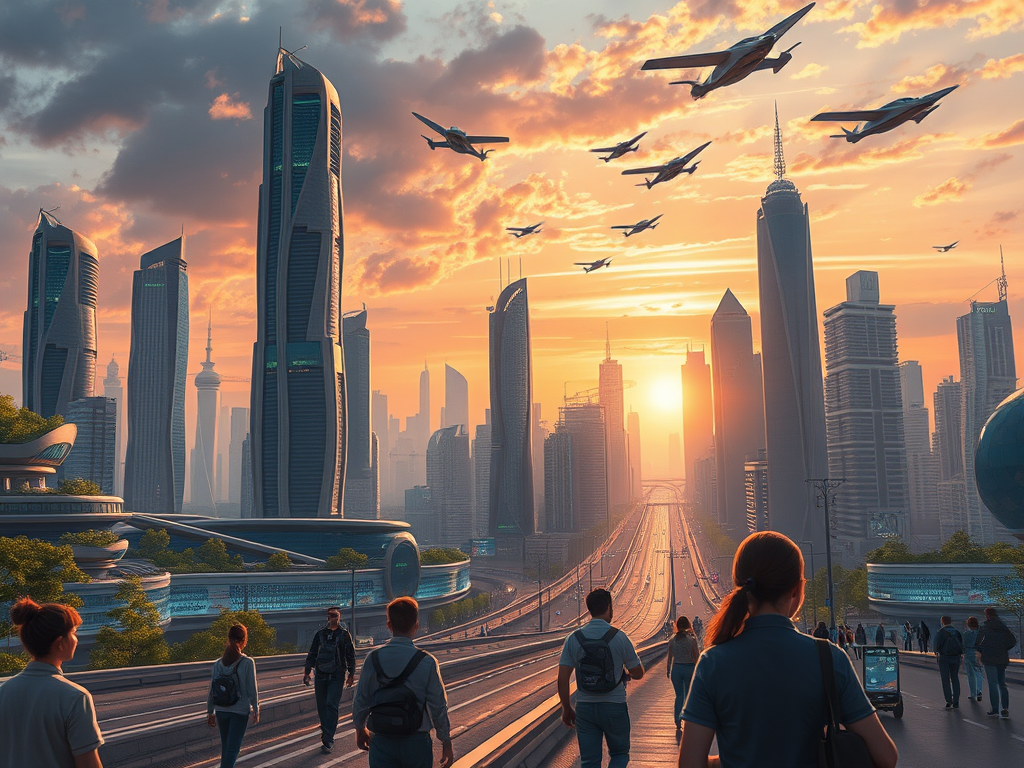
The world in 2050 is likely to be vastly different from the one we know today, shaped by rapid technological advancements, shifting demographics, and a growing focus on sustainability. Society will be characterized by megacities, with urban areas becoming home to more than 70% of the global population. These cities will rely heavily on smart technologies to manage resources efficiently, optimize transportation, and enhance the quality of life for their residents.
Lifestyles in 2050 will reflect an increased emphasis on health and well-being. Advances in medical science, including personalized medicine and nanotechnology, will allow people to live longer and healthier lives. Wearable health monitors and AI-driven healthcare systems will provide real-time insights, enabling early detection of diseases and tailored treatments. Additionally, the way people consume food will change significantly. Vertical farming and lab-grown meat will dominate urban agriculture, reducing the environmental impact of food production and ensuring food security for a growing population.
The careers of the future will also undergo profound transformations. Automation and artificial intelligence will take over routine tasks, freeing up human workers to focus on creative and strategic roles. Professions in fields like renewable energy, robotics, and biotechnology will thrive, while lifelong learning will become essential to adapt to rapidly changing industries. Gig economy platforms and remote work will offer unprecedented flexibility, allowing individuals to pursue multiple careers throughout their lives.
Transportation and communication will be seamlessly integrated in 2050. Self-driving vehicles will dominate roads, while hyperloop systems will enable high-speed travel between cities. Flying taxis may become commonplace, reshaping urban landscapes and eliminating traffic congestion. On the communication front, 6G networks and brain-computer interfaces could revolutionize how we interact, making it possible to transmit thoughts directly and collaborate in virtual spaces.
However, achieving this vision of 2050 will depend on global cooperation and the responsible use of technology. As society becomes increasingly interconnected, addressing issues like climate change, data privacy, and inequality will be critical. With careful planning and innovation, the world in 2050 could be a place of remarkable progress, opportunity, and inclusivity.
Glossary
- Megacity (noun) – a very large city, typically with a population of over 10 million people. e.g., “Tokyo and Mumbai are examples of megacities.”
- Sustainability (noun) – the ability to maintain or support something over the long term without causing harm to the environment. e.g., “Sustainability is a key goal for future urban development.”
- Nanotechnology (noun) – the science of manipulating materials on an atomic or molecular scale. e.g., “Nanotechnology is revolutionizing medical treatments.”
- Vertical farming (noun) – the practice of growing crops in vertically stacked layers, often in urban settings. e.g., “Vertical farming reduces the land required for agriculture.”
- Lab-grown meat (noun) – meat produced in a laboratory from cultured animal cells. e.g., “Lab-grown meat offers an environmentally friendly alternative to traditional meat.”
- Automation (noun) – the use of machines or technology to perform tasks without human intervention. e.g., “Automation is reshaping industries by taking over repetitive jobs.”
- Gig economy (noun) – a labor market characterized by short-term, flexible work rather than permanent jobs. e.g., “The gig economy allows people to work on a project-by-project basis.”
- Hyperloop (noun) – a high-speed transportation system in which pods travel through low-pressure tubes. e.g., “The hyperloop could revolutionize long-distance travel.”
- Brain-computer interface (noun) – a technology that enables direct communication between the brain and external devices. e.g., “Brain-computer interfaces may redefine how humans interact with technology.”
- Inclusivity (noun) – the practice of including people of all backgrounds, abilities, and perspectives. e.g., “Inclusivity is essential for building a fair and equitable society.”
Comprehension Questions
1. What is one way cities in 2050 will adapt to increasing urban populations?
Correct Answer: b. By implementing smart technologies. Smart technologies will optimize resources and improve urban living.
2. What will be a significant change in healthcare by 2050?
Correct Answer: b. Use of wearable health monitors and AI-driven systems. Healthcare advancements will focus on real-time insights and personalized treatments.
3. Which profession is likely to grow in importance by 2050?
Correct Answer: a. Renewable energy specialists. Careers in renewable energy and technology will thrive in the future.
4. How might communication evolve by 2050?
Correct Answer: c. Using brain-computer interfaces and 6G networks. These technologies could transform interaction and collaboration.
Discover more from EDUCATION FOR PEACE FOUNDATION
Subscribe to get the latest posts sent to your email.