[Opening: The Vision of Mars] “With space agencies and private companies racing to reach Mars, the idea of living on the Red Planet no longer seems like pure science fiction. But what would life on Mars actually look like?”
[Daily Life on Mars] “Living on Mars would mean adapting to a completely different environment. Days on Mars are almost as long as Earth’s—24 hours and 37 minutes—but that’s where the similarities end. Temperatures can plummet to minus 80 degrees Fahrenheit, and the thin atmosphere, filled with carbon dioxide, is unbreathable. Residents would need to live in protective habitats equipped with oxygen generators and climate control.”
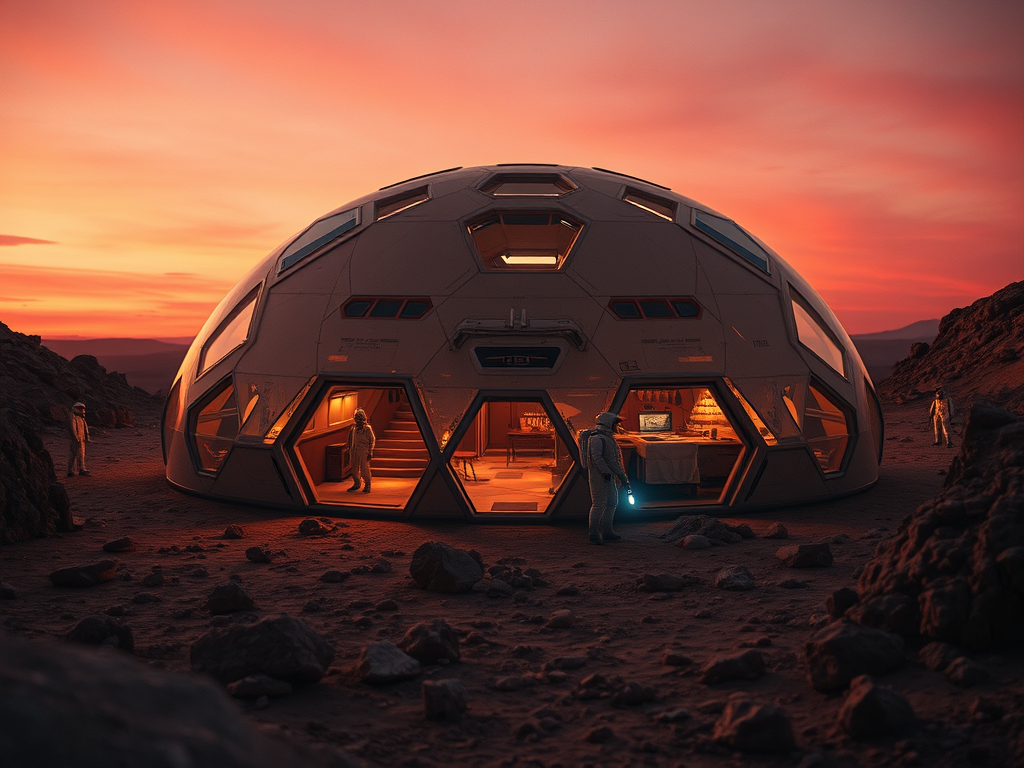
[Communities and Architecture] “Future Martian settlements might resemble interconnected domes or underground bunkers to shield inhabitants from radiation. These structures would need to be made from durable materials, potentially sourced from Martian soil itself, known as regolith. Inside, the habitats would have everything from sleeping quarters to research labs and communal areas designed to maintain a sense of community and comfort.”
[Food and Water] “Growing food on Mars would be a challenge, but not impossible. Scientists are already experimenting with ways to cultivate crops in controlled environments using hydroponics or nutrient-rich Martian soil treated to support plant life. Water, extracted from the ice beneath the planet’s surface, would be a precious resource, recycled extensively to meet the needs of the community.”
[Daily Routines and Activities] “Daily life would focus on survival and exploration. Residents might spend their days maintaining technology, conducting research, and venturing outside in specially designed suits to explore Mars’ rocky landscapes. Recreation would be vital for mental health, with activities adapted for low gravity, like unique sports or indoor games.”
[Society and Challenges] “Living on Mars would reshape human social structures. With time delays of up to 20 minutes between Earth and Mars, communities would have to be largely independent, making decisions without real-time advice from Earth. Adaptability and teamwork would be essential traits. But isolation, limited resources, and potential health impacts from lower gravity would pose significant psychological and physical challenges.”
[The Vision of a Martian Future] “Despite the hurdles, life on Mars holds the promise of something extraordinary: a new chapter for humanity. It’s a chance to build a society from scratch, with lessons learned from Earth. Imagine generations born and raised on Mars, calling it their true home.”
[Closing: The Great Adventure] “So, what would life on Mars be like? It would be difficult, innovative, and transformative. It’s a bold experiment that could push human limits and expand the boundaries of what we know about life, survival, and exploration.”
Discover more from EDUCATION FOR PEACE FOUNDATION
Subscribe to get the latest posts sent to your email.