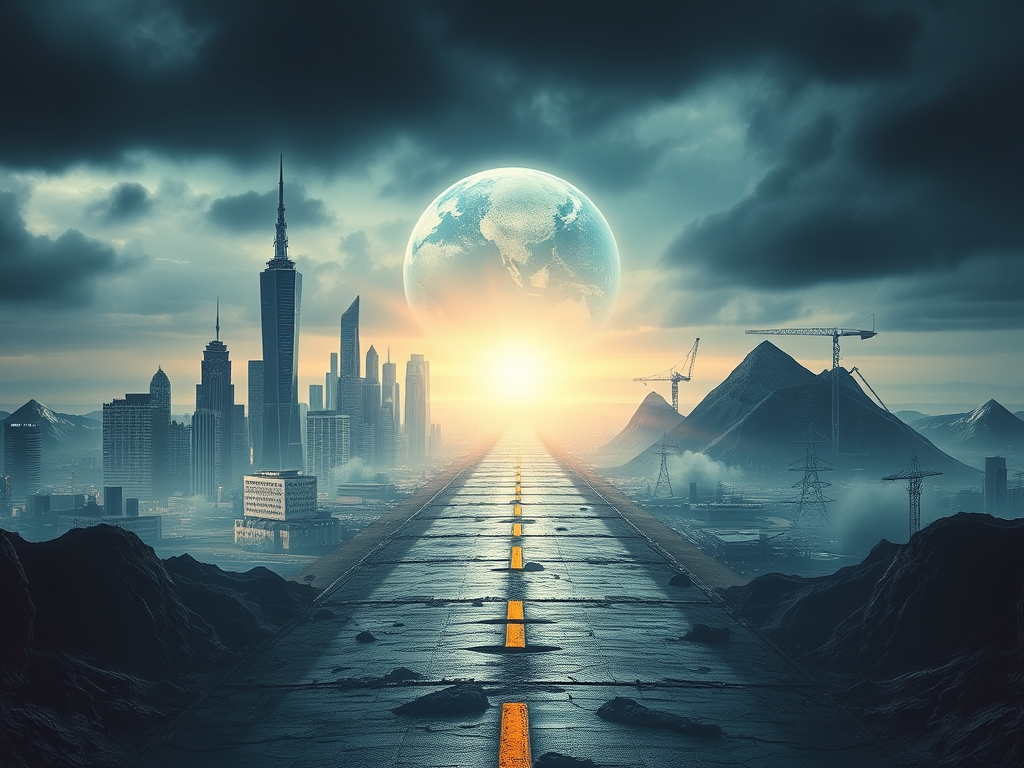
A Warning to Humanity: The Risks Threatening the Course of Our Civilization
In the 21st century, humanity stands at a crossroadsNoun: A point where a crucial decision must be made., wielding unprecedented technological, cultural, and political power while facing existentialAdjective: Relating to existence, especially human survival. risks that could fundamentally alter or even destroy the trajectory of our global civilizations. The interconnectednessNoun: The state of being connected with each other. of our world—through technology, trade, and communication—has amplified both our potential for progress and our vulnerabilityNoun: The quality of being easily harmed or attacked. to catastrophic failures. Drawing from historical lessons, such as the transformation of Western civilizations during the fall of the Western Roman Empire, we can identify parallels to modern risks that threaten the stability, cohesion, and survival of our societies. This essay serves as a warning, outlining the most pressing dangers—technological, environmental, societal, and geopolitical—that could reshape or unravel the fabric of global civilization if left unaddressed.
1. Technological Risks: The Double-Edged Sword of Innovation
Humanity’s technological advancements, while transformative, pose risks capable of altering civilization’s course. Artificial intelligence (AI), biotechnology, and cyber systems are at the forefront of these concerns.
Artificial Intelligence and Automation: AI’s rapid development, exemplified by systems capable of autonomousAdjective: Acting independently or having the freedom to do so. decision-making, raises existential questions. Unregulated AI could lead to unintended consequences, such as autonomous weapons systems escalating conflicts beyond human control or AI-driven economic disruption causing mass unemployment. For instance, studies suggest automation could displace 20–30% of current jobs in developed economies by 2030, exacerbating inequalityNoun: The unfair difference in wealth, opportunities, or privileges. and social unrest. Without global governance frameworks, a misaligned superintelligent AI could prioritize goals incompatible with human survival, a scenario warned about by thinkers like Nick Bostrom.
Cybersecurity Threats: Our reliance on interconnected digital infrastructure makes civilizations vulnerable to cyberattacks. A coordinated attack on critical systems—power grids, financial markets, or communication networks—could paralyzeVerb: To bring to a complete halt or make powerless. entire nations. The 2021 Colonial Pipeline ransomware attack, which disrupted fuel supplies in the United States, is a small-scale example of the chaos possible. State-sponsored cyber warfare or terrorist exploitation of these vulnerabilities could escalate into global crises.
Biotechnological Risks: Advances in genetic engineering, such as CRISPR, enable breakthroughs but also risks. The potential for bioterrorismNoun: The use of biological agents to cause harm or terror. or accidental release of engineered pathogens could trigger pandemics far deadlier than COVID-19, which killed over 7 million people globally by 2025. The democratizationNoun: The process of making something accessible to everyone. of bioengineering tools increases the likelihood of misuse by rogue actors, echoing historical plagues that decimated societies unprepared for biological threats.
These technological risks mirror the Roman Empire’s overreliance on complex systems—like its military and trade networks—which collapsed under external and internal pressures. Without proactive regulation and ethical oversight, our technological prowess could become our undoingNoun: The cause of ruin or downfall..
2. Environmental Collapse: The Ticking Clock of Climate Change
Climate change is the most immediate existential threat to global civilization, with impacts already reshaping societies. Rising global temperatures, extreme weather, and resource depletion threaten food security, population displacement, and economic stability.
Extreme Weather and Resource Scarcity: The Intergovernmental Panel on Climate Change (IPCC) projects that, without drastic emissions cuts, global warming could exceed 3°C by 2100, leading to catastrophic consequences. In 2024 alone, hurricanes, wildfires, and floods displaced millions and caused billions in damages. Droughts in regions like the Horn of Africa have triggered famine, while water scarcity fuels conflicts in the Middle East and South Asia.
Mass Migration and Social Strain: Climate-induced migration could displace 1.2 billion people by 2050, according to the Institute for Economics and Peace. This scale of movement risks overwhelming infrastructure, sparking xenophobiaNoun: Fear or hatred of foreigners or strangers., and destabilizing governments, particularly in densely populated regions like South Asia and Europe. Historical parallels, such as the migration of Germanic tribes contributing to Rome’s fall, highlight how mass displacement can strain civilizations to breaking points.
Biodiversity Loss: The collapse of ecosystems—coral reefs, rainforests, and pollinator populations—threatens food chains and agricultural systems. The World Economic Forum estimates that half of global GDP depends on nature, yet 1 million species face extinction. This loss undermines the resilienceNoun: The ability to recover quickly from difficulties. of civilizations, much like the depletion of fertile lands weakened Roman agriculture.
Failure to act decisively—through global cooperation, renewable energy adoption, and sustainable practices—could render vast regions uninhabitable, triggering societal collapse on a scale unseen since antiquity.
3. Societal Fragmentation: The Erosion of Cohesion
Internal divisions within societies, amplified by technology and ideology, threaten the social contracts that underpin modern civilizations.
Polarization and Misinformation: Social media platforms, while connective, have fueled polarizationNoun: The division into two sharply contrasting groups or sets of beliefs. by creating echo chambers and spreading misinformation. X posts from 2024–2025 reveal growing distrust in institutions, with conspiracy theories and divisive rhetoric undermining democratic processes. The January 6, 2021, U.S. Capitol riot demonstrated how polarized narratives can lead to violence, echoing the civil wars that fractured Rome’s cohesion.
Inequality and Social Unrest: Global wealth inequality is at historic highs, with the richest 1% owning nearly half of global wealth (Oxfam, 2025). Economic disparity breeds resentment, fueling populist movements and civil unrest. Historical examples, like the Roman Empire’s reliance on a shrinking elite amidst an impoverished populace, show how inequality can destabilize societies.
Cultural and Ideological Clashes: Competing visions of identity—based on religion, ethnicity, or ideology—are fracturing societies. From debates over immigration in Europe to cultural conflicts in multiethnic states, these tensions risk escalating into violence or authoritarianismNoun: The enforcement of strict obedience to authority at the expense of personal freedom., as seen in the rise of far-right and far-left movements globally.
Without efforts to foster dialogue, equity, and shared values, societies risk fragmenting into irreconcilable factions, weakening the resilience needed to face external threats.
4. Geopolitical Instability: The Fragility of Global Order
The global order is under strain, with rising powers, declining alliances, and nuclear risks threatening peace.
Great Power Rivalry: Tensions between the United States, China, and Russia mirror the imperial rivalries of the past. The Ukraine conflict (2022–ongoing) and Taiwan Strait tensions highlight the potential for escalationNoun: A rapid increase in the intensity or seriousness of something.. A miscalculation could lead to conventional or nuclear war, with catastrophic consequences. The Center for Strategic and International Studies estimates a 1% annual risk of nuclear conflict, a low but terrifying probability.
Decline of Global Cooperation: Institutions like the United Nations and World Trade Organization face declining influence, hampering responses to global challenges like pandemics or climate change. The Roman Empire’s division into East and West weakened its ability to respond to threats; similarly, today’s fragmented geopolitics undermines collective action.
Resource Wars and Proxy Conflicts: Competition for dwindling resources—water, rare earth minerals, arable land—could spark conflicts. Proxy wars in regions like the Middle East and Africa, often fueled by external powers, destabilize entire regions, creating power vacuums akin to those that allowed Germanic tribes to overrun Roman territories.
A breakdown in global cooperation or an escalation of conflicts could plunge the world into chaos, erasing centuries of progress.
A Call to Action: Learning from History
The fall of the Western Roman Empire teaches us that civilizations are not destroyed by a single blow but by a cascade of interconnected failures—political dysfunction, economic decline, external pressures, and societal decay. Today, we face analogous risks, amplified by the scale and speed of our globalized world. Yet, unlike Rome, we have the knowledge, technology, and foresight to act.
To avert these dangers, humanity must:
- Regulate Technology Ethically: Establish global frameworks for AI safety, cybersecurity, and biotechnology to prevent misuse while harnessing their benefits.
- Combat Climate Change: Accelerate decarbonization, invest in resilience, and support vulnerable regions to mitigate environmental collapse.
- Bridge Societal Divides: Promote education, dialogue, and equitable policies to reduce polarization and inequality.
- Strengthen Global Cooperation: Reform international institutions and prioritize diplomacy to manage geopolitical tensions and resource conflicts.
The risks we face are daunting, but they are not inevitable. By learning from the past and acting with urgency, humanity can steer its civilizations away from collapse and toward a sustainable, equitable future. The choice is ours—but the clock is ticking.
Discover more from EDUCATION FOR PEACE FOUNDATION
Subscribe to get the latest posts sent to your email.