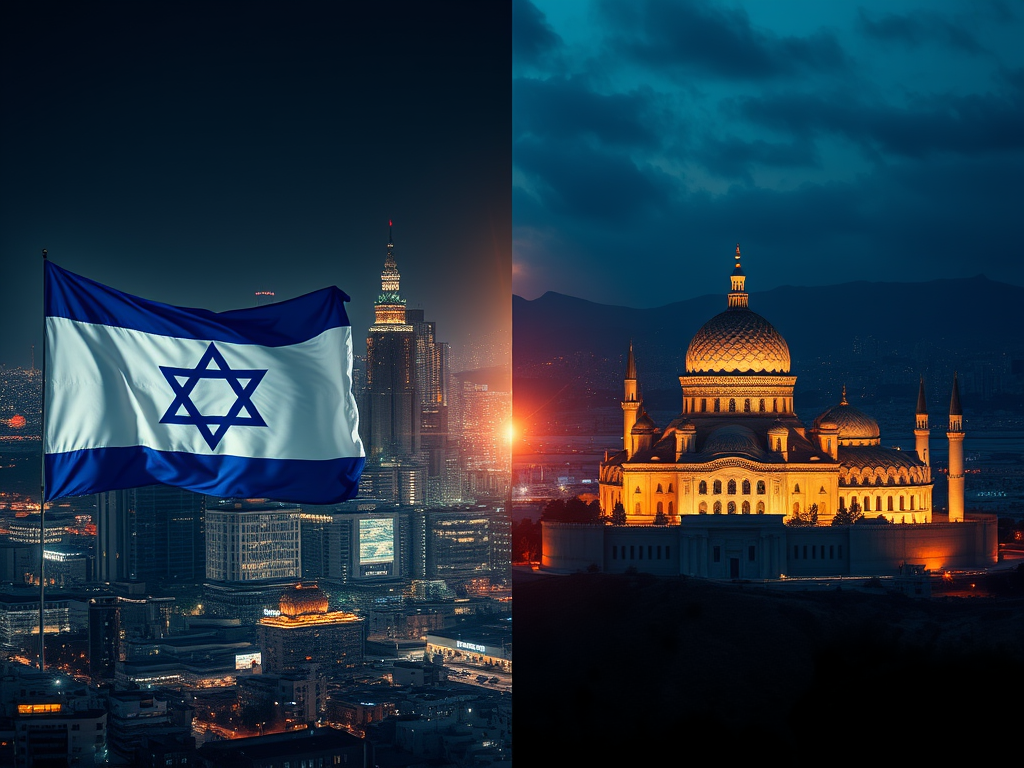
Israel and Iran: From Former Partners to Present Enemies
Looking beyond prejudice to understand the structures, history, and war now shaking the Middle East
The conflict between Israel and Iran is often interpreted through the lens of personal sympathies, hatreds, religious loyalties, or political ideologies. In doing so, many people forget a crucial point: if we do not understand the fundamental nature of these two states, we easily become victims of simplistic narratives that force us to “choose sides.”
Some automatically portray Israel as the villain. Others instinctively cast Iran as the victim. Yet when we look deeper at the structural level, a far more complex reality emerges.
1. How the Two States Differ Structurally
To understand this conflict, we must begin with the nature of the two states themselves.
Israel is a parliamentary democracy with competitive multi-party elections. Its economy is driven by technology, innovation, research, and deep integration with the Western world. Although Israel experiences intense political disagreements and frequent criticism of its governments, the core structure of the state remains anchored in modern institutions, checks and balances, and a knowledge-based economy.
Iran, under the Islamic Republic, operates under a fundamentally different structure. It combines elements of electoral politics with the ultimate authority of a religious supreme leader. In other words, while some institutions resemble those of a republic, the true center of power lies within the revolutionary religious system and the network of the Islamic Revolutionary Guard Corps (IRGC), which wields enormous influence over national security, politics, and large sectors of the economy.
In terms of population, Iran is far larger. Recent World Bank estimates place Iran’s population at roughly 91.6 million people, compared with about 10 million in Israel. However, a larger population does not necessarily translate into greater state capacity.
Economically, the contrast becomes striking. Israel’s GDP in recent estimates stands around 540 billion US dollars, while Iran’s is approximately 475 billion dollars, despite Iran having nearly nine times the population. Israel’s per-capita income is dramatically higher, reflecting major differences in productivity, technological development, institutional efficiency, and integration into the global economy.
Militarily, Israel possesses a qualitative advantage. Its strengths include advanced command systems, intelligence networks, drone technology, cyber capabilities, air defense systems, and long-range strike capacity.
Iran’s strengths lie elsewhere. It possesses strategic geographic depth, a much larger population base, a wide network of armed proxy groups across the region, and a significant arsenal of ballistic missiles.
Put simply, Israel’s strength lies in precision and technological sophistication. Iran’s strength lies in strategic depth and regional networks. This is why the conflict between the two countries is not simply a conventional army-against-army war. It operates across multiple layers: intelligence operations, missile warfare, cyber conflict, economic pressure, and proxy warfare.
2. What Many People Do Not Know: Israel and Iran Were Once Allies
Many people assume that Israel and Iran have always been enemies. This assumption is incorrect.
During the reign of Shah Mohammad Reza Pahlavi, before the Islamic Revolution of 1979, Iran maintained close relations with both the United States and Israel. The Iranian monarchy at that time adopted a more secular orientation, embraced Western engagement, and cooperated with Israel across multiple areas, including security, energy, and regional strategy.
This relationship was part of the older security architecture of the Middle East. Under the Shah, Iran viewed itself as a major regional power responsible for maintaining balance between Arab nationalism, Soviet influence, and Western strategic interests.
This fact is critically important. It means that the conflict we see today did not arise because Persians and Jews “naturally hate one another,” nor is it purely a religious conflict. Rather, it emerged from a profound transformation in political regime.
When Iran shifted from a Western-aligned monarchy to a revolutionary religious state that defined itself partly through opposition to the United States and Israel, the entire relationship reversed dramatically.
In other words, the true historical divide is not between ethnic groups, but between political systems and ideologies that changed radically after 1979.
3. The Year 1979: The Breaking Point
The Iranian Revolution of 1978–1979 represents the most decisive turning point in this relationship.
When the Shah’s regime collapsed, the Islamic Republic under Ayatollah Ruhollah Khomeini came to power. The new regime built its legitimacy through strong anti-imperialist rhetoric and explicit opposition to both the United States and Israel.
The close ties between the Shah and these countries became one of the factors fueling revolutionary resentment. After the revolution, the new leadership sought to sever those strategic relationships completely.
From that moment onward, Israel was no longer simply a geopolitical rival for Iran. It became a symbol of ideological opposition and a central element in the revolutionary identity of the Iranian state.
At the same time, Israel increasingly viewed the new Iranian regime as an existential threat, particularly as Iran began building networks of armed influence across the region and advancing nuclear ambitions that drew close international scrutiny.
4. Why Iran Is Seen as a Major Threat by Israel
Observers who strongly sympathize with Iran often overlook a key reality: Israel does not see Iran merely as a diplomatic rival.
Instead, Israel sees Iran as a state actively building the capability to pressure and surround it through networks of armed proxies across the region.
Iran maintains relationships with numerous militant groups and allied forces, including Hezbollah in Lebanon, Shiite militias in Iraq, and the Houthis in Yemen. These networks significantly expand Tehran’s regional influence and ability to threaten adversaries.
Such networks are not abstract concepts. They are real instruments of state power projection beyond Iran’s borders.
For Israel, the perceived danger becomes even more serious when these proxy networks are combined with Iran’s nuclear ambitions. International monitoring agencies have repeatedly expressed concern about uranium enrichment levels and transparency issues surrounding Iran’s nuclear program.
This reality reinforces Israel’s security doctrine. As a small state surrounded by historical adversaries, Israel’s strategic mindset has long been guided by a simple principle: never allow a hostile power that openly questions your existence to obtain the ultimate weapons of destruction.
5. A Long Shadow War
The war between Israel and Iran did not suddenly begin in recent years. It has been unfolding for a long time in the form of a shadow war.
Over the past decade and more, both sides have engaged in covert and indirect operations. These have included cyberattacks, targeted assassinations, airstrikes on Iranian-linked facilities in Syria, attacks on shipping, sabotage of nuclear infrastructure, and proxy-based retaliation.
Both sides have been maneuvering strategically for years. Yet for a long time the outside world treated each incident as an isolated event, rather than recognizing it as part of a cumulative conflict gradually escalating toward open confrontation.
This shadow war often produces misunderstanding. People who follow only daily headlines tend to see isolated incidents without recognizing the larger strategic pattern.
Iran relies on strategic depth and proxy networks to balance Israel’s power. Israel relies on superior intelligence and technological capabilities to neutralize threats before they fully mature.
When both sides believe they are acting to prevent their own destruction or encirclement, trust becomes nearly impossible.
6. What the War Looks Like Today
As of March 11, 2026, the situation has moved beyond ordinary tension into a state of active military confrontation.
Recent reports describe attacks affecting economic infrastructure, shipping routes, energy systems, and civilian facilities. Strategic waterways such as the Strait of Hormuz have become areas of intense concern for the global economy.
Once conflict begins to disrupt maritime trade, energy supply routes, and financial systems, it ceases to be a local dispute between two states. It becomes a global geopolitical risk.
At the same time, even within Israel’s own strategic assessments, there remains uncertainty about whether the current war will lead to the collapse of the Iranian regime.
This point is crucial. Wars can cause immense destruction without necessarily producing a clear political transformation.
7. Why So Many People See This Conflict Through Bias
Public opinion about this conflict is often shaped by strong ideological biases.
Some people despise Israel so intensely that they overlook the nature of the Iranian regime itself. Others see the phrase “anti-imperialism” and immediately assume that Tehran represents the righteous side.
Yet the Iranian state also operates through strict religious authority, suppression of internal dissent, cross-border militant networks, and rhetoric that frames enemies in existential terms.
On the other hand, there are also those who support Israel so uncritically that they refuse to acknowledge the heavy civilian suffering that military power inevitably produces.
Reality cannot be forced into simplistic moral boxes where one side represents angels and the other demons. The world is far more complicated.
But rejecting simplistic narratives does not mean sanitizing reality either. Portraying the Iranian regime as merely a helpless victim is also a distortion.
One must distinguish between the Iranian people and the Islamic Republic as a governing system. Sympathy for the people does not erase the responsibilities of the state.
8. What Humanity Should Learn
The most important lesson from the Israel-Iran conflict is that we must abandon shallow interpretations of global politics.
Not every actor claiming to defend the oppressed actually produces freedom. Not every actor invoking security is free from responsibility for human suffering.
At a minimum, we should recognize that Israel and Iran were not destined to be enemies. Their hostility emerged from radical changes in political regime and ideology.
Since 1979, the Iranian revolutionary state has defined part of its identity through opposition to Israel. Israel, in response, has hardened its security doctrine accordingly.
Over time, cycles of deterrence and retaliation have solidified into a structural pattern across the region.
Humanity can only “open its eyes” when it accepts three realities simultaneously: that civilian suffering is real, that state responsibility is real, and that political structures producing war are real.
When states build their identity upon permanent hostility, and when opposing states respond with uncompromising survival logic, the greatest burden rarely falls upon elites.
It falls upon ordinary people—in Iran, in Israel, and across a region dragged into conflict they never chose.
Conclusion
The conflict between Israel and Iran is not about which side is “more lovable.” It is about two fundamentally different kinds of states that view one another as threats to their survival.
The past reminds us that they were once capable of cooperation. The present shows how dramatically political revolutions can transform geopolitics. And the current war demonstrates how ideological hostility combined with modern military power can shake the entire world.
If we must begin our compassion somewhere, let it begin with the ordinary people who live under the shadow of regimes, under the shadow of missiles, and under the shadow of narratives that tear truth into fragments—until humanity forgets to question the roots of war itself.
Discover more from EDUCATION FOR PEACE FOUNDATION
Subscribe to get the latest posts sent to your email.